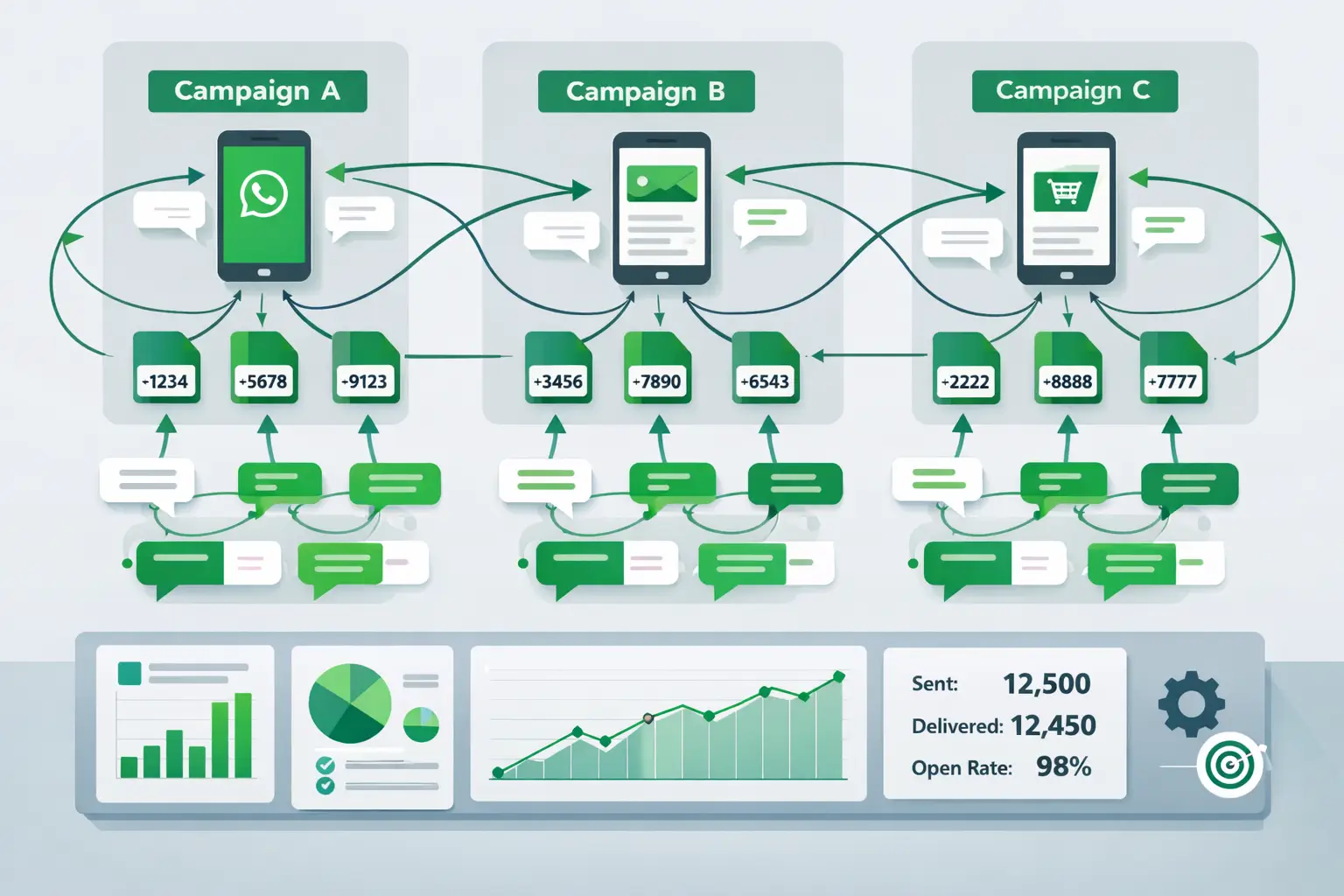
How Agencies Manage Multiple WhatsApp Campaigns Without Delivery Risk
Multiple WhatsApp campaigns
For agencies, WhatsApp marketing looks easy from the outside.
But behind the scenes, it is one of the most fragile channels to manage at scale.
One mistake in one campaign can:
-
Drop delivery across other campaigns
-
Affect multiple clients at once
-
Damage the agency’s credibility
That is why agencies constantly worry about delivery risk.
This blog explains how smart agencies manage multiple WhatsApp campaigns without delivery risk, what usually causes failures, and how the right systems turn WhatsApp into a reliable channel instead of a daily headache.
Why Running Multiple WhatsApp Campaigns Is Risky
Multiple WhatsApp campaigns
An agency does not run campaigns like a single business.
Agencies:
-
Handle many clients at the same time
-
Run campaigns in parallel
-
Share tools, numbers, and systems
-
Work under tight deadlines
This creates overlapping activity, which WhatsApp systems notice quickly.
WhatsApp does not see:
-
Client names
-
Campaign labels
-
Agency intentions
It only sees patterns.
How WhatsApp Sees Agency Activity (This Is Important)
Multiple WhatsApp campaigns
WhatsApp evaluates behavior across:
-
Message volume
-
Sending speed
-
Content repetition
-
User reactions
This logic is explained clearly in
how WhatsApp detects promotional abuse through volume, patterns, and signals.
If several campaigns look similar or aggressive, WhatsApp reacts — even if only one client caused the problem.
That is why agencies face shared risk.
The Biggest Mistakes Agencies Make
Multiple WhatsApp campaigns
Most delivery problems are not bad luck.
They come from repeatable mistakes.
Common agency errors include:
-
Using the same WhatsApp numbers for multiple clients
-
Sending messages too fast to meet deadlines
-
Reusing similar templates across campaigns
-
Relying on cheap bulk WhatsApp tools
These shortcuts work briefly — then fail suddenly.
How Smart Agencies Reduce Delivery Risk
Multiple WhatsApp campaigns
Professional agencies do not rely on hope.
They rely on structure.
Here is how they protect delivery while running many campaigns.
1. Isolating Campaign Risk (One Client ≠ Everyone)
Multiple WhatsApp campaigns
The first rule is simple:
One client’s campaign should never affect another.
Smart agencies ensure:
-
Campaigns are separated
-
Load is not mixed blindly
-
Failures stay contained
This isolation protects both delivery and reputation.
2. Distributed Sending Is Mandatory for Agencies
Multiple WhatsApp campaigns
Agencies that scale safely use
distributed sending for WhatsApp promotions.
This means:
-
Messages are spread across multiple numbers
-
Each number stays within safer limits
-
Load is balanced across campaigns
Without distributed sending, agencies overload numbers — and delivery collapses.
3. Controlling Speed Across All Campaigns
Multiple WhatsApp campaigns
Speed feels productive.
Speed is also dangerous.
Smart agencies:
-
Control sending speed
-
Avoid sudden message spikes
-
Balance traffic across time
This prevents triggering
WhatsApp promotional abuse detection.
When pacing is controlled, delivery stays predictable.
4. Content Discipline Across Clients
Multiple WhatsApp campaigns
Reusing templates saves time — but increases risk.
Professional agencies:
-
Vary content between clients
-
Avoid copy-paste blasting
-
Use human-style language
This aligns with best practices explained in
send WhatsApp mass messages that convert.
Better content protects delivery and improves results.
5. Following a Clear Campaign Flow
Multiple WhatsApp campaigns
Chaos increases risk.
Smart agencies follow a defined
WhatsApp promotional campaign flow
for every campaign:
-
Upload
-
Send
-
Monitor
-
Report
Structure removes guesswork — especially when many campaigns run together.
Why Cheap Tools Hurt Agencies the Most
Cheap WhatsApp tools are built for individual users, not agencies.
As explained in
why cheap WhatsApp marketing often leads to number blocks,
cheap tools usually:
-
Depend on single numbers
-
Ignore engagement signals
-
Collapse under multi-campaign load
For agencies, this is not just a tool problem — it is a business risk.
How MsgReach Helps Agencies Stay in Control
MsgReach is designed with agencies in mind.
It helps agencies:
-
Run multiple campaigns simultaneously
-
Isolate delivery risk
-
Distribute message load safely
-
Maintain delivery stability
-
Avoid false promises like guarantees
This honest approach aligns with
why guaranteed WhatsApp delivery is a false claim.
What Successful Agencies Focus On
High-performing agencies focus on:
-
Stability over speed
-
Systems over shortcuts
-
Long-term number health
-
Client trust
Agencies that think this way grow more reliably, as seen in
how businesses in India are growing 10x faster with WhatsApp marketing service.
Final Takeaway
Managing multiple WhatsApp campaigns is not about sending more messages.
It is about controlling risk at scale.
Agencies avoid delivery problems by:
-
Isolating campaigns
-
Using distributed sending
-
Controlling pace
-
Maintaining content discipline
-
Using platforms built for scale
With the right system, agencies can run many WhatsApp campaigns confidently — without fearing sudden delivery failures.
FAQs: Agencies and Multiple WhatsApp Campaigns
Why do agencies face higher WhatsApp delivery risk?
Because multiple campaigns create overlapping patterns, higher volume, and shared infrastructure risks.
Can one bad campaign affect other clients?
Yes. If risk is not isolated, WhatsApp may restrict shared numbers or patterns.
Is distributed sending necessary for agencies?
Yes. It is essential for managing multiple campaigns safely.
Are cheap WhatsApp tools safe for agencies?
No. Most cheap tools are not designed for multi-campaign environments.
Does MsgReach support agencies with many clients?
Yes. MsgReach is built to handle multiple campaigns with controlled risk.
What is the biggest agency mistake?
Choosing speed and low cost over delivery stability and system design.