How WhatsApp Detects Promotional Abuse: Volume, Patterns, and Signals (Explained Simply)
WhatsApp promotional abuse detection is the reason many WhatsApp marketing campaigns stop performing after a few days. WhatsApp does not randomly ban numbers—it evaluates message volume, sending patterns, and user reactions to identify promotional abuse.
Many businesses believe WhatsApp bans happen suddenly or without reason.
That belief is incorrect.
WhatsApp does not randomly block numbers. It follows a clear detection system that evaluates how messages are sent, how users react, and how consistent the behavior looks over time.
If you are running WhatsApp campaigns—or planning to—this blog will help you understand exactly what WhatsApp looks at and why most promotional campaigns fail silently.
Before going further, it is important to clearly understand what bulk WhatsApp marketing actually is and how it works, because abuse detection is directly connected to how campaigns are executed.
Why WhatsApp Actively Monitors Promotional ActivityWhatsApp is designed for personal conversations, not mass advertising.
To protect users, WhatsApp continuously monitors promotional behavior.
WhatsApp promotional abuse detection is the system WhatsApp uses to identify risky bulk messaging behavior based on volume, patterns, and user signals.
When a system notices activity that feels:
-
Automated
-
Aggressive
-
Repetitive
-
Unwanted
…it starts applying restrictions.
This is why many businesses see good delivery for a few days and then suddenly face issues. If you are unsure how bulk WhatsApp messages are usually sent by businesses, you will miss this connection.
Signal #1: Message Volume per Number (Most Critical)
WhatsApp evaluates each sending number individually.
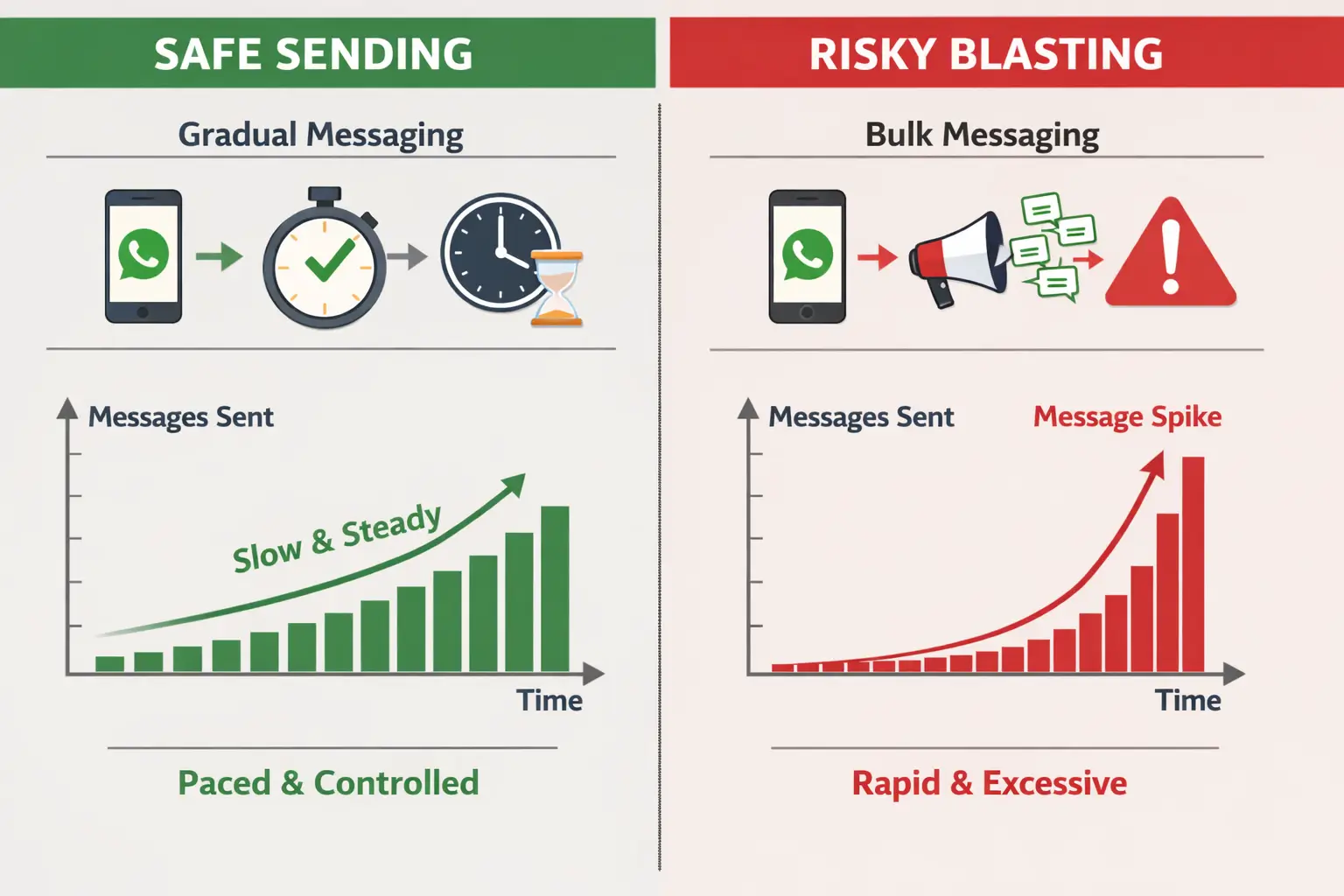
Safe behavior looks like:
-
Gradual sending
-
Limited daily volume
-
Natural gaps between messages
Risky behavior looks like:
-
Thousands of messages from one number
-
Sudden volume spikes
-
Continuous sending without pauses
Most low-quality tools fail here, which is why platforms that ignore limits are exposed in the truth about bulk WhatsApp marketing services and what to avoid.
Volume abuse is the fastest way to lose trust.
Signal #2: Message Repetition and Pattern Similarity
WhatsApp systems compare structure, not intention.
Even if your offer is genuine, sending:
-
The same text
-
The same links
-
The same call-to-action
…to thousands of users creates an automation footprint.
High-performing campaigns focus on variation and relevance, which is why smart marketers follow strategies explained in how to send WhatsApp mass messages that actually convert.
Repetition signals spam. Variation signals legitimacy.
Signal #3: User Reactions After Receiving Messages
WhatsApp observes what happens after delivery.
https://www.whatsapp.com/legal/business-policy/
Negative signals include:
-
Users blocking the number
-
Marking messages as spam
-
Ignoring messages repeatedly
A few complaints are normal. A pattern of complaints is not.
This is where targeting becomes critical, as discussed in AI-powered WhatsApp bulk messaging in India.
Poor targeting produces poor feedback—and feedback trains the system.
Signal #4: Sending Speed and Time Behavior
Humans do not send hundreds of messages per minute.
WhatsApp tracks:
-
Messages per minute
-
Time gaps between sends
-
Unnatural activity at late-night hours
Tools that send too fast get flagged quickly.
This is why automation must follow logic, as explained in WhatsApp marketing in 2025 and responsible automation.
Automation without pacing equals detection.
Signal #5: Link Usage and Domain Trust
Links play a major role in abuse detection.
WhatsApp evaluates:
-
Domain reputation
-
Repeated link usage
-
Suspicious redirects
Businesses that educate users using their own content—like structured resources from MsgReach blogs—naturally build safer link profiles.
Shortened or unknown domains increase risk.
Why “No Ban” Promises Are a Red Flag
No tool can control WhatsApp’s internal systems.
Claims like:
-
“100% safe”
-
“No ban guarantee”
-
“Unlimited blasting”
…are misleading.
This is why businesses must carefully evaluate providers using guides like how to choose the right WhatsApp marketing service provider.
Transparency matters more than promises.
How Smart Delivery Systems Reduce Detection Risk
Reliable platforms do not fight WhatsApp’s logic.
They align with it.
They focus on:
-
Distributed sending
-
Controlled per-number volume
-
Natural pacing
-
Campaign-level monitoring
This approach explains why many Indian brands are scaling responsibly, as shown in how businesses in India are growing 10x faster with WhatsApp marketing services.
Systems matter more than speed.
Why Location-Based Campaigns Matter
User tolerance differs by region.
Metro cities like Mumbai, Pune, and Bangalore have:
-
Higher competition
-
Faster spam reporting
-
Lower patience for irrelevant messages
Local relevance reduces negative signals.
AI and Automation: Power With Responsibility
AI improves:
-
Message variation
-
Timing optimization
-
Audience segmentation
But it does not remove limits.
Businesses exploring advanced workflows must understand how AI WhatsApp marketing systems support compliance—not shortcuts.
AI multiplies discipline, not mistakes.
Common Mistakes That Trigger Abuse Detection
Let’s correct common myths:
❌ Faster sending does not improve delivery
❌ More numbers without logic still fail
❌ Cheap databases increase spam reports
❌ Copy-paste content creates patterns
If scale is your goal, study how to send 10,000 WhatsApp messages correctly instead of blasting blindly.
Final Summary
https://www.whatsapp.com/legal/business-policy/
WhatsApp does not block businesses.
It blocks irresponsible behavior patterns.
Campaigns succeed when they respect:
-
Volume limits
-
Pattern variation
-
User experience
-
Trust signals
If you want to understand how professional systems design campaigns around these rules, explore MsgReach and its expertise framework before choosing any solution.
FAQs
Does WhatsApp read message content?
No. It evaluates behavior patterns and user reactions.
Can any provider guarantee safety?
No. Such claims are misleading.
Is automation unsafe?
Only when used without pacing and logic.
Why do new numbers fail faster?
They lack historical trust signals.
Is WhatsApp marketing still effective?
Yes—when done correctly and ethically.